


Page 14 - Circular Connector Backshells and Accessories
P. 14
How to Order
                                                        Circular Connector Backshells
        How
       to Order

                                                               moplastic materials as an alternative to conductive
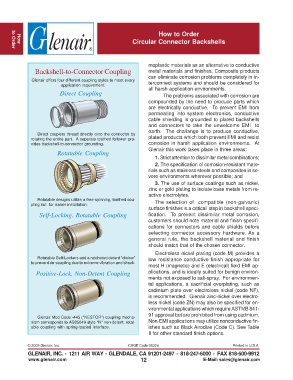
                Backshell-to-Connector Coupling                metal materials and finishes. Composite products
                                                               can eliminate corrosion problems completely in in-
              Glenair offers four different coupling styles to meet every  terconnect systems and should be considered for
                           application requirement:
                                                               all harsh application environments.
                          Direct Coupling                            The problems associated with corrosion are
                                                               compounded by the need to produce parts which
                                                               are electrically conductive.  To prevent EMI from
                                                               permeating into system electronics, conductive
                                                               cable shielding is grounded to plated backshells
                                                               and connectors to take the unwelcome EMI  to
                                                               earth.  The challange is to produce conductive,
                 Direct couplers thread directly onto the connector by
              rotating the entire part.  A separate toothed follower pro-  plated products which both prevent EMI and resist
              vides backshell-to-connector grounding.          corrosion in harsh application environments.  At
                                                               Glenair this work takes place in three areas:
                         Rotatable Coupling
                                                                  1. Strict attention to dissimilar metal combinations;
                                                                  2. The specification of corrosion-resistant mate-
                                                               rials such as stainless steels and composites in se-
                                                               vere environments wherever possible; and
                                                                  3. The use of surface coatings such as nickel,
                                                               zinc or gold plating to isolate base metals from re-
                                                               active electrolytes.
                 Rotatable designs utilize a free-spinning, toothed cou-
              pling nut  for easier installation.                 The selection of  compatible (non-galvanic)
                                                               surface finishes is a critical  step in backshell speci-
                  Self-Locking, Rotatable Coupling             fication.  To prevent dissimilar metal corrosion,
                                                               customers should note material and finish specifi-
                                                               cations for connectors and cable shields before
                                                               selecting connector accessory hardware. As a
                                                               general rule, the backshell material and finish
                                                               should match that of the chosen connector.
                                                                  Electroless nickel plating (code M) provides a
                 Rotatable Self-Lockers add a ratcheted detent "clicker"  low resistance conductive finish appropriate for
              to prevent de-coupling due to extreme vibration and shock.
                                                               most H (magnetic) and E (electrical) field EMI ap-
                Positive-Lock, Non-Detent Coupling             plications, and is ideally suited for benign environ-
                                                               ments not exposed to salt-spray.  For environmen-
                                                               tal applications, a sacrificial overplating, such as
                                                               cadmium plate over electroless nickel (code NF),
                                                               is recommended.  Glenair zinc-nickel over electro-
                                                               less nickel (code ZN) may also be specified for en-
                                                               vironmental applications which require ASTMB 841-
                                                               91 approval but are prohibited from using cadmium.
                 Glenair Mod Code -445 ("NESTOR") coupling mecha-
              nism corresponds to AS85049 style "N" non-detent, rotat-  Non-EMI applications may utilize nonconductive fin-
              able coupling with spring-loaded interface.      ishes such as Black Anodize (Code C). See Table
                                                               II for other standard finish options.


             © 2005 Glenair, Inc.                      CAGE Code 06324                            Printed in U.S.A.
             GLENAIR, INC. • 1211 AIR WAY • GLENDALE, CA 91201-2497 • 818-247-6000 • FAX 818-500-9912
             www.glenair.com                                12                        E-Mail: sales@glenair.com

